He Could Have Escaped,Yet He Willingly Remained

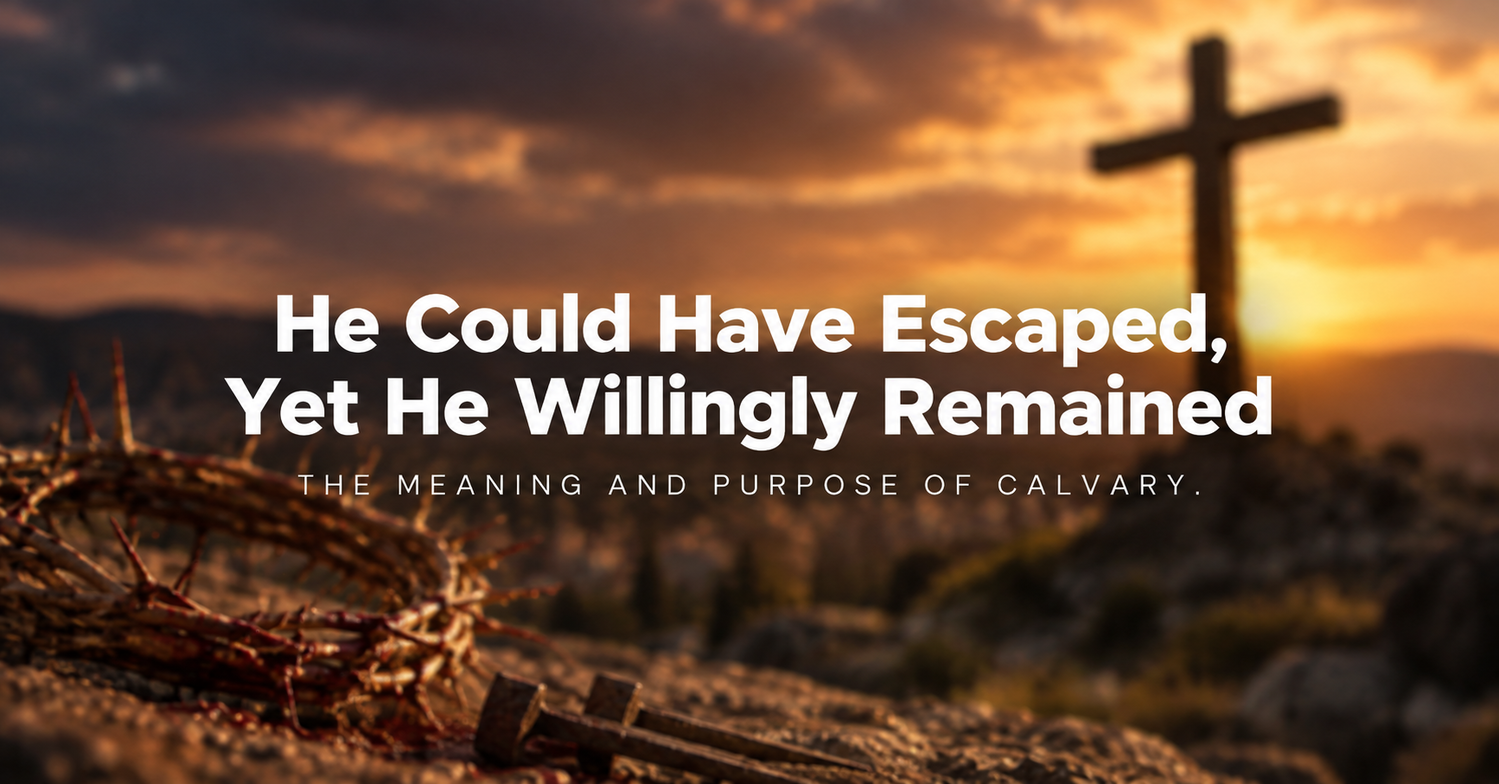
The suffering of Jesus Christ at Calvary represents far more than an extraordinary display of human cruelty. Every lash, every thorn, every agonizing breath, and every moment of humiliation was endured by the sinless Son of God. Yet what makes the crucifixion so profound is not merely the severity of His suffering, but the voluntary nature of His sacrifice. Christ was never a helpless victim of human circumstances; He was the willing Redeemer accomplishing the eternal purposes of God.
When confronted with arrest in Gethsemane, Jesus reminded His disciples that He possessed the authority to summon more than twelve legions of angels (Matthew 26:53). His submission, therefore, was neither evidence of weakness nor an inability to resist His accusers. The One through whom all things were created willingly subjected Himself to the cruelty of fallen humanity. His restraint demonstrated perfect obedience to the Father rather than submission to the ultimate authority of men.
Furthermore, Scripture establishes that the crucifixion was not an unforeseen tragedy but the fulfillment of God's sovereign redemptive plan. Peter declared that Christ was delivered up according to the definite plan and foreknowledge of God (Acts 2:23). Centuries earlier, Isaiah foretold a suffering servant who would bear the iniquities of many (Isaiah 53:4–6). At Calvary, divine justice and mercy converged as Christ willingly endured the penalty deserved by sinners.
The theological significance of this sacrifice cannot be overstated. Humanity's fundamental problem is not merely moral imperfection but guilt before a holy God. Consequently, reconciliation requires more than ethical improvement or religious devotion. It requires an acceptable sacrifice. Through His perfect obedience and substitutionary death, Christ accomplished what fallen humanity could never achieve through its own righteousness.
Jesus Himself declared, “No one takes it from me, but I lay it down of my own accord” (John 10:18). His words establish that the cross was not simply something inflicted upon Him, but a sacrifice He willingly offered.
Perhaps most humbling is the realization that Christ accomplished this redemption for those entirely undeserving of divine mercy. As Romans 5:8 declares, while we were still sinners, Christ died for us.
The cross, therefore, leaves no room for human boasting. Salvation rests entirely upon the grace of God and the finished work of Jesus Christ.
He possessed every power to escape Calvary, yet willingly remained to accomplish the redemption of His people.
About
Contact
Office Hours
